TWO:The Act of 1712 restored lay patronage, and then the strife began, but not between the people and the lay pastors, but between the clergy and the lay patrons. There grew up two parties in the General Assembly, styled the moderates, and the more advanced, or popular party. The moderates were those who were ready to concede to the demands of Government and lay patronage under a gentle protest; the more popular party, as it was called, was for transferring the right of presentation to the presbytery. The Act of William III., in 1690, gave the original and exclusive nomination to the heritors, land-owners, and elders. The person nominated was to be proposed to the congregation, who might approve or disapprove. But to what did this right amount? The congregation could not absolutely reject; and if they disapproved, the right passed on to the presbytery, whose decision was final. By this arrangement, either the landowners and elders remained the presenters,[168] or, after a vain show of conferring the choice upon the people, the appointment fell to the clergy, or presbytery. From 1690 to 1712, Sir Henry Moncrieff says, "there does not appear the least vestige of a doctrine, so much contended for at a later period, of a divine right in the people individually or collectively, to elect the parish minister." This opinion was fully maintained by the law of William III., in 1690, and confirmed by that of Anne, in 1712. Sir Henry Moncrieff, in confirmation of this doctrine that the people never had a right to elect their ministers in the Scottish Church, quotes the "First Book of Discipline," of 1567, which placed the election of pastors in the people at large; but this error, he says, was rectified by the "Second Book of Discipline," in 1581. By this book the congregation could only consent¡ªthe presbyters must finally determine. This contains the law of the Church of Scotland, and the great schism which took place in the Scottish Church, in 1843¡ªknown as the Disruption¡ªarose merely from the resistance to lay patronage, but with the intention of transferring that patronage to the clergy, not the people.
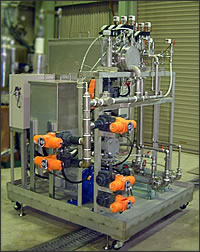
A hydrocyclone (liquid cyclone) injects treatment solution into stationary equipment to perform separation, classification, and concentration, and is an innovative separator with a very simple structure and no drive unit.
Structure of a hydrocyclone (liquid cyclone)
A suspension containing fine particles of several micrometers or more is supplied to a cylindrical container circumferentially at high speed. And as a result it starts to rotate and a centrifugal force is generated. At this time a gravitational acceleration of several tens of thousands of G is generated in the circumferential direction, and thus leading to fast sedimentation and concentration of the fine particles. The separated concentration can be freely selected by changing the supply rate (supply pressure and flow rate) and the flow ratio of the outlet. Our hydrocyclone (liquid cyclone) was designed and manufactured to classify and concentrate fine particles, and so has a small element.
THREE:The force left to keep possession of Cabul and guard the prot¨¦g¨¦ of the Indian Government[495] was so situated as to tempt the aggression of a treacherous enemy. Sir William Macnaghten, the British Resident, and his suite, resided in the Mission Compound, which was badly defended, and commanded by a number of small forts, while the commissariat stores were placed in an old fort, detached from the cantonment and in such a state as to be wholly indefensible. Moreover, General Elphinstone, the commander of the troops, was old and inefficient. A conspiracy had been formed by the friends of Akbar Khan, son of the deposed sovereign, Dost Mahomed, who forged a document, and had it circulated amongst the principal men of Cabul, to the effect that it was the design of the British envoy to send them all to London, and that the king had issued an order to put the infidels all to death. The insurrection commenced by an attack on the dwellings of Sir Alexander Burnes, who was about to succeed Macnaghten, and Captain Johnson, who resided in the city. Sir Alexander addressed the party from the gallery of his house, thinking that it was a mere riot. The insurgents, however, broke in, killed him with his brother, Lieutenant Burnes, and Lieutenant Broadfoot, and set the house on fire. The Afghans then surrounded the cantonments, and poured in a constant fire upon them from every position they could occupy. They quickly seized the ill-defended commissariat stores, upon which the existence of the British depended. The garrison bravely defended itself with such precarious supplies as could be had from the country; but at length these supplies were exhausted. Winter set in, snow fell, and there was nothing before them but the prospect of starvation. They therefore listened to overtures for negotiation, and the British envoy was compelled to consent to these humiliating terms on the 11th of December, 1841:¡ªThat the British should evacuate the whole of Afghanistan, including Candahar, Ghuznee, and Jelalabad; that they should be permitted to return unmolested to India, and have supplies granted on their road thither; that means of transport should be furnished to the troops; that Dost Mahomed Khan, his family, and every Afghan then detained within our territories should be allowed to return to their own country; that Shah Sujah and his family should receive from the Afghan Government one lac of rupees per annum; that all prisoners should be released; that a general amnesty should be proclaimed; and that no British force should ever be sent into Afghanistan without being invited by the Afghan Government. These terms having been agreed to, the chiefs took with them Captain Trevor as a hostage; but nothing was done to carry the agreement into effect, and Macnaghten and Elphinstone remained irresolutely at Cabul. Some of their staff attempted to bribe the Afghans, and Akbar Khan thereupon determined to withhold supplies. It soon became evident that the object was to starve out the garrison, and compel them to surrender unconditionally. At length, on the 22nd of December, they sent two persons into the cantonment, who made a proposal in the name of Akbar Khan, that the Shah should continue king, that Akbar should become his Prime Minister, and that one of the principal chiefs should be delivered up to the British as a prisoner. This was a mere trap, into which Sir William Macnaghten unfortunately fell with fatal credulity. On the 23rd of December the envoy, attended by Captains Lawrence, Trevor, and M'Kenzie, left the Mission Compound, to hold a conference with Akbar Khan in the plain towards Serah Sung. Crowds of armed Afghans hovering near soon excited suspicions of treachery. Captain Lawrence begged that the armed men might be ordered off; but Akbar Khan exclaimed, "No, they are all in the secret." At that instant Sir William and the three officers were seized from behind and disarmed. Sir W. Macnaghten was last seen on the ground struggling violently with Akbar Khan, consternation and terror depicted on his countenance. "His look of wondering horror, says Kaye, "will never be forgotten by those who saw it, to their dying day." The other three officers were placed on horses, each behind a Ghilzai chief, who galloped off with them to a fort in the neighbourhood. Captain Trevor fell off his horse, and was instantly murdered. The others were assailed with knives by the infuriated Afghans, and barely escaped to the fort with their lives. Meanwhile the head of the British Minister was cut off and paraded through the streets, while the bleeding and mangled trunk was exposed to the insults of the populace in the principal bazaar.
- Equipment costs can be reduced.
- Operating costs can be reduced.
- Maintenance costs can be reduced.
- Any change in raw material and product can be easily addressed.
- Large amounts can be treated in a small area.
- Separation and cleaning are easy because of the simple structure.
- Simplified control
- This equipment can be operated in synchronization with external devices.
- Alarm and interlock mechanism.
THREE:On the 31st of March Dundas introduced the Indian Budget, and soon afterwards Pitt congratulated the country on the fact that, so far from the American war having injured the trade or the power of Britain, the fact was that our shipping had increased considerably more than one-third since 1773, and we had been continually gaining strength even during the American war, and had relieved ourselves of a load of expense always incurred by the government of the States. This was an admirable argument for declaring all our colonies independent, if it meant anything; but Pitt went on seconding, and even surpassing Dundas in the prognostications of a long peace. What such ministerial speeches were worth was shown on the 5th of May, only a month and five days since the prophecy of Dundas, and not three weeks since his own prophecy, by Pitt announcing that the peace was already disturbed with Spain. It appeared that the high prices obtained by the crews of Captain Cook's ships, the Discovery and Resolution, at Canton, on his exploring voyages in the South Seas, for the ill-selected, half-worn furs brought from the north-west coast of America, had attracted the attention of adventurers under the direct protection of the East India Company. Mr. Mears, who had been a lieutenant in the royal navy, and a Mr. Tippin, were sent out in command each of a vessel. Tippin was wrecked on the coast of Kamtschatka; but Mears reached Prince William's Sound and wintered there, opening a good trade with the natives. In the spring of 1788 he discovered Nootka Sound, a fine bay on the west side of a small island on the west coast of Vancouver's Island. There he formed a settlement, making a bargain with the chief for it. He went to Canton with furs and was opening a fine trade, when the Spaniards came down on the settlement, seized four British vessels, but permitted two United States' vessels to remain unmolested. Part of the English crew were shipped in one of the American vessels to China, and the rest suffered to depart in one of their own ships after it had been plundered. The Spanish commander then settled himself in the new colony, and Spain set up a[372] general claim to all coasts and islands, and the whole Pacific as far as China.
- Classification and concentration for the manufacture of inorganic powder materials
- Classification of ceramic materials
- Removal of fine particles, including iron powder
- Removal of fine particles from pigments
- Removal of fine organic particles from solvents
- Separation of starch and yeast
- Removal of fine particles from high-temperature strong acid solutions
- Removal of fine particles from low-temperature solutions